
By: Jeff Johnson, Karly Wentz, Nate Johnson and Eric Brook
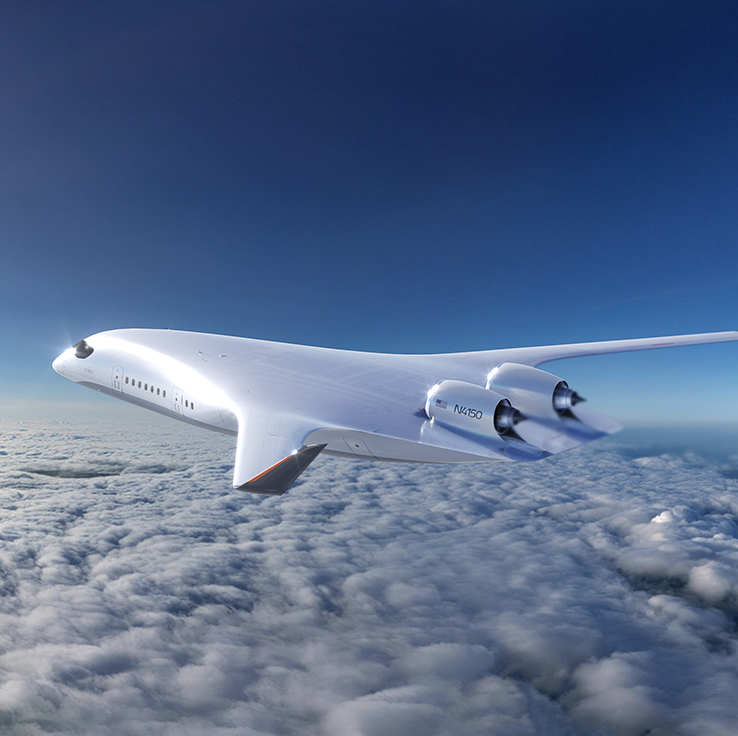
B Capital is proud to partner with JetZero, a next-generation aircraft manufacturer redefining aviation through breakthrough design and best-in-class aerodynamics. The company’s blended-wing-body aircraft, designed for commercial, cargo and government use cases, can deliver up to a 50% improvement in fuel efficiency compared to today’s aircraft.1
JetZero unlocks its step-change efficiency gains using technologies that airlines, regulators and airports can adopt in the near-future, without waiting decades for new systems or infrastructure. This approach directly addresses airlines’ largest cost driver while fitting seamlessly within today’s airline and airport infrastructure. The first commercial delivery is forecast for the early 2030s, with early flight demonstrations as soon as 2027.
For partner airlines such as United Airlines, Delta Air Lines and Alaska Airlines, this will translate into lower operating costs and an improved passenger experience. The same platform also supports highly efficient cargo configurations and meaningful advantages for transport and tanker missions, including aerial refueling, thereby likely expanding JetZero’s addressable market beyond commercial aviation.
Aviation Faces Structural Constraints
For decades, progress in aviation efficiency has been driven by incremental improvements. Advancements in engines, materials and winglets delivered meaningful efficiency gains in prior generations, but additional optimization is yielding diminishing marginal returns. As those returns shrink, meaningful progress requires changes at the aircraft architecture level rather than continued refinement of the tube-and-wing, which has remained largely unchanged for nearly a century.
That legacy design is increasingly misaligned with industry realities: jet fuel is the largest operating cost for airlines, while decarbonization pressure continues to intensify. These challenges are compounded by a Boeing-Airbus duopoly in which unprecedented order backlogs, risk aversion and legacy incentives limit the ability of incumbents to launch disruptive new aircraft programs.
Meanwhile, global demand for air travel continues to grow while the levers available to improve economics and reduce emissions are becoming constrained. Many proposed solutions focus on future propulsion systems that require new infrastructure, new certification pathways or fundamental changes to airline operations. While potentially promising in the long-term, these approaches do little to address the near-term efficiency gap facing the global fleet.
Compounding this challenge is the gap between single-aisle and wide-body aircraft. Many medium-haul routes fall between what narrow-bodies can serve efficiently and what wide-bodies are designed for. Narrow-bodies often lack the required payload, range or seat economics, while wide-bodies are oversized and inefficient for these flights. As a result, airlines are forced to deploy aircraft that are poorly matched to demand, driving excess fuel burn and higher operating costs. A 2018 ICF study estimated that the “missing middle” represents one of the largest underserved segments in global aviation, spanning roughly 20–30% of global airline routes and representing hundreds of billions of dollars in potential market opportunity, reflecting a structural gap that continues to persist across global fleets today.2
JetZero’s Approach: Aerodynamics Over New Propulsion
The aviation industry is pursuing multiple paths to improve sustainability and economics. Sustainable aviation fuel is a drop-in solution but remains supply constrained and more expensive than conventional jet fuel. Hydrogen and electric propulsion promise deep emissions reductions but require new aircraft architectures, new infrastructure and new regulatory frameworks that will take decades to mature and often face significant range or payload limitations.
JetZero takes a different approach, focusing on the single largest efficiency lever available today: aerodynamics. By fundamentally improving how lift is generated and drag is reduced, JetZero delivers immediate, material efficiency gains while remaining compatible with existing engines, infrastructure and regulatory pathways. These gains compound across the system, reducing fuel burn, structural weight and thrust requirements.
JetZero’s Z4 aircraft is purpose-built for today’s market. With seating capacity of 200-250 passengers and ranges spanning domestic, transatlantic and select long-haul routes, the Z4 is designed as a direct replacement for aging 757 and 767 fleets, while outperforming both modern narrow-body and wide-body alternatives on cost per seat.3 That same efficiency profile translates directly to cargo operations, improving payload and fuel economics on medium- and long-haul freight routes.
Crucially, JetZero achieves these gains using existing engine technology and certified systems. Rather than waiting on hydrogen, batteries or regulatory reinvention, the aircraft is designed to operate within current FAA certification and airline operating frameworks. Advances in digital design tools, modern composites and certified off-the-shelf systems now make large-scale blended-wing-body aircraft manufacturable and certifiable for the first time.
We believe the underlying technology is materially de-risked. The design builds on more than 30 years of government and industry research and over $1B in cumulative investment across NASA, the U.S. Department of War and commercial aerospace programs.4,5 The program is now approaching a major de-risking milestone, with a full-scale non-commercial demonstrator and first flight planned in the near term, reducing remaining technical and execution risk.
Built for Real-World Operations and Execution
JetZero is designing the aircraft to fit within existing airport infrastructure and airline operations, without requiring new gates, jet bridges or specialized ground equipment. The blended-wing-body layout enables wider seats, higher ceilings and configurable cabin zones while potentially supporting faster turnaround times and more efficient boarding at congested hubs.
For passengers, this translates to a meaningfully differentiated experience: more spacious seating across all classes, wider aisles, reduced boarding congestion, improved overhead storage and cabin layouts that support quieter, more comfortable travel. Unlike incremental cabin retrofits, these improvements are structural, not cosmetic.
The development program combines aerospace rigor with a modern execution mindset. JetZero is vertically integrated where it matters most, owning the aircraft structure and flight control systems and sourcing certified components from established suppliers to reduce certification risk and non-recurring engineering. This execution model prioritizes capital deployment toward the most complex technical areas, supporting a more capital-efficient path from development through certification and into production.
Strong Validation from Partners
JetZero has secured meaningful commercial validation from leading airlines that are committing both capital and aircraft demand. United Airlines has invested in the company and entered into a conditional purchase agreement for 100 aircraft, with options for an additional 100.6 Alaska Airlines has also invested and secured early production positions, while Delta Air Lines is deeply engaged across aircraft design, operations and other contributions.7,8 Together, these partnerships reflect airline confidence not only in the aircraft’s economics but in JetZero’s ability to execute a clean-sheet program at scale.
The company also maintains deep connectivity with the U.S. Air Force on a full-scale demonstrator program supported by over $200 million in non-dilutive funding.9 For the Air Force, the platform is expected to deliver extended range, increased payload flexibility and lower fuel and logistics costs across transport and tanker missions. These capabilities address critical limitations of the aging tanker fleet.
In parallel, JetZero has secured significant non-dilutive state-level support from North Carolina tied to manufacturing and workforce development, further improving the capital efficiency of the program.10
The Right Team to Build a Market-Defining Company
Building a clean-sheet commercial aircraft requires rare depth across engineering, certification and industrial execution. JetZero’s leadership team blends experience scaling complex hardware programs with deep commercial aerospace expertise, including senior roles at Tesla, BETA Technologies, Boeing, SpaceX, Gulfstream and Northrop Grumman.
JetZero is led by CEO and co-founder Tom O’Leary, who previously held senior leadership roles at Tesla and served as COO at aerospace startup BETA Technologies, bringing an execution-driven operating mindset shaped by scaling complex hardware programs alongside a strong focus on customer outcomes and disciplined program delivery.
A Structural Shift in Commercial Aviation
We believe the aviation industry is at an inflection point. Passenger demand is growing, fuel and emissions constraints are tightening and incumbent OEMs face record backlogs with limited incentive to launch disruptive new programs. Airlines, regulators and governments are aligned around the need for real efficiency gains that can be delivered within current operational and regulatory frameworks.
By delivering a fundamentally more efficient aircraft using proven technologies, optimized for airline economics and flexible across passenger, cargo and government applications, JetZero is positioned to reshape a core segment of aviation. It is redefining what is possible within the constraints that actually matter.
At B Capital, we focus on companies that enable step-change improvements in critical infrastructure systems. JetZero represents that opportunity in aviation. We are proud to invest in JetZero as it advances toward demonstration flight and commercial service, and we look forward to supporting the company as it works to deliver a more efficient, resilient and competitive aviation industry.
The investment was led by Jeff Johnson (General Partner, Head of Energy Tech at B Capital), alongside Karly Wentz (Partner, Energy Tech), with investment team members Nate Johnson and Eric Brook.
LEGAL DISCLAIMER
All information is as of 1.5.2026 and subject to change. The investment discussed herein is a portfolio company of B Capital; however, such investment does not represent all B Capital investments. Certain statements reflected herein reflect the subjective opinions and views of B Capital personnel. Such statements cannot be independently verified and are subject to change. Reference to third-party firms or businesses does not imply affiliation with or endorsement by such firms or businesses. It should not be assumed that any investments or companies identified and discussed herein were or will be profitable. Past performance is not indicative of future results. The information herein does not constitute or form part of an offer to issue or sell, or a solicitation of an offer to subscribe or buy, any securities or other financial instruments, nor does it constitute a financial promotion, investment advice or an inducement or incitement to participate in any product, offering or investment. Much of the relevant information is derived directly from various sources which B Capital believes to be reliable, but without independent verification. This information is provided for reference only and the companies described herein may not be representative of all relevant companies or B Capital investments. You should not rely upon this information to form the definitive basis for any decision, contract, commitment or action.
SOURCE
- Alaska Airlines, Alaska Airlines announces investment in JetZero to propel innovative aircraft technology and design, August 13, 2024
- Boeing, Commercial Market Outlook, 2025-2044, 2025
- Delta Air Lines, Delta, JetZero partner to design the future of air travel by advancing first-of-its-kind, 50% more fuel-efficient aircraft for domestic and international routes, March 5, 2025
- EESI, S. and International Commitments to Tackle Commercial Aviation Emissions, January 31, 2025
- European Federation for Transport and Environment, The aviation industry and the stall in aircraft innovation, June 18, 2025
- ICF, Making the Case for a Middle of the Market Aircraft, 2018
- International Air Transport Association, Net zero 2050: new aircraft technology, December 2025
- International Air Transport Association, Reviving the Commercial Aircraft Supply Chain, October 2025
- International Air Transport Association, Unveiling the biggest airline costs, June 4, 2024
- International Council on Clean Transportation, Fuel burn of new commercial jet aircraft: 1960 to 2024, January 2025
- JetZero, United Invests in Next Generation Blended Wing Aircraft Start-Up JetZero, April 24, 2025
- McKinsey & Company, Fuel efficiency: Why airlines need to switch to more ambitious measures, March 2022
- Politico, Why electric aircraft may never be the next big thing, January 24, 2024
- S&P Global, Airlines see relief with $86 jet fuel, SAF costs hinder sustainability: IATA chief, June 2, 2025
- Scientific American, Hydrogen-Powered Airplanes Face 5 Big Challenges, May 4, 2024
- Seabury Capital Group, JetZero CEO Lands A Silicon Valley Mindset at U.S. Chamber of Commerce Global Aviation Summit, September 17, 2025
- University of Illinois, Grainger College of Engineering, Blended wing brings air travel greater range, fuel efficiency, and comfort, June 26, 2024